As digital payments scale across UPI, cards, wallets, and BNPL, reconciliation is no longer a simple back-office task; it becomes a system-level challenge.
What once worked in spreadsheets starts to break under the weight of fragmented data, multiple payment sources, and inconsistent settlement cycles.
Finance teams today are not just matching transactions; they are trying to make sense of delayed settlements, fee deductions, refunds, and mismatches across systems. At this scale, manual reconciliation doesn’t just slow things down; it limits visibility and introduces risk into financial tracking.
This is where AI-driven reconciliation changes the equation. Instead of relying on manual effort, businesses can move toward system-driven matching, reducing reconciliation time, improving accuracy, and gaining faster, more reliable visibility into settlement flows.
TL;DR (Quick Summary)
AI-driven reconciliation helps businesses:
- Reduce reconciliation time from hours to minutes in many cases
- Improve accuracy by reducing manual intervention and errors
- Handle high-volume, multi-source payment data more efficiently
- Identify mismatches and exceptions earlier in the process
- Gain clearer visibility into settlements and transaction flows
What Is Settlement Reconciliation?
Settlement reconciliation is the process of matching transaction data across a business’s internal systems, payment gateways, and bank settlement reports to ensure that all payments are accurately accounted for.
Typically, this involves comparing records from:
- Internal systems such as ERP or accounting software
- Payment gateways that process transactions
- Bank statements reflecting actual settlements
In practice, these records rarely match perfectly on the first pass, especially as transaction volumes increase.
Example
Consider a D2C business that records ₹10,00,000 in successful transactions on its payment gateway. However, the bank account reflects only ₹9,85,000 credited.
This difference can arise due to several factors, including:
- MDR (merchant discount rate) fees are deducted by the payment processor
- Refunds or reversals processed after the initial transaction
- Failed or partially settled transactions
- Settlement timing differences, such as T+1 or T+2 cycles
It is important to note that settlements are typically credited net of fees, refunds, and chargebacks, which is why the amount received in the bank often differs from the gross transaction value recorded at the gateway level.
Why Traditional Reconciliation Breaks at Scale
Manual reconciliation may work when transaction volumes are low, but it becomes increasingly difficult to manage as businesses grow and payment complexity increases.
As transaction volumes scale, finance teams are required to handle multiple moving parts at once. This includes managing large datasets, aligning records across systems, and accounting for varying settlement timelines — all of which increase operational strain.
In practice, this leads to several challenges, such as:
- Handling thousands of transactions across multiple payment modes such as UPI, cards, and wallets
- Dealing with data inconsistencies across payment gateways, banks, and internal systems
- Managing different settlement cycles, including T+1, T+2, or longer delays
- Increased risk of human error when relying on spreadsheets
- Delays in reporting and limited visibility into settlement status
As scale grows, these challenges compound quickly as transaction volumes increase and payment flows become more complex.
At this stage, reconciliation needs to move from manual effort to system-driven matching. This is where AI changes the equation.
How AI Settlement Reconciliation Works
AI-driven reconciliation systems automate the transaction matching process while improving speed and accuracy through structured workflows and intelligent logic.
Key Stages in the Process
1. Data Ingestion
Transaction data is collected from multiple sources, including payment gateways, banks, and internal systems. This is typically done through APIs, file uploads, or real-time data feeds, ensuring that all relevant information is available in one place.
2. Data Normalization
Once collected, the data is standardized into a consistent format. This step involves cleaning inconsistencies in timestamps, transaction IDs, and naming conventions so that records from different systems can be compared accurately.
3. Intelligent Matching Engine
At the core of the system is the matching engine, which uses a combination of rule-based logic and machine learning models to reconcile transactions. This allows the system to handle complexities such as partial matches, delayed settlements, and split transactions without manual intervention.
4. Exception Detection
Transactions that cannot be matched automatically or appear inconsistent are flagged as exceptions. These are categorized into issues such as missing settlements, duplicate transactions, or fee mismatches, making them easier to investigate and resolve.
5. Automated Reconciliation & Reporting
The majority of transactions are reconciled automatically, while the system generates dashboards and reports that provide near real-time visibility into settlement status, discrepancies, and overall reconciliation performance.
AI vs Manual Reconciliation
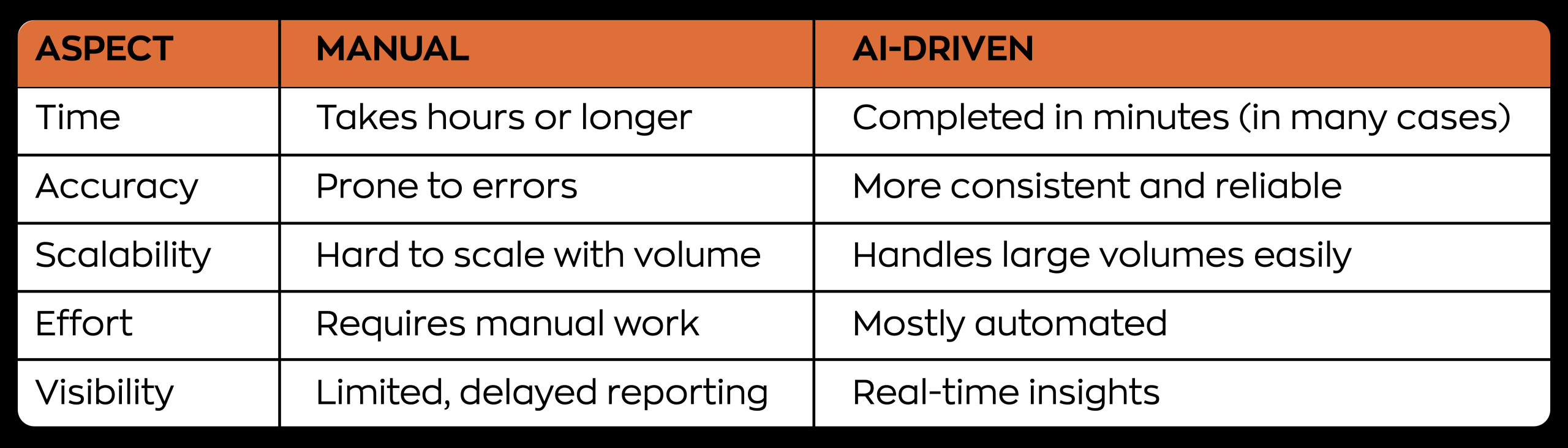
Manual reconciliation typically involves downloading reports, cleaning data, and matching entries in spreadsheets — a process that is both time-consuming and prone to errors, especially as transaction volumes increase.
In contrast, AI-driven reconciliation systems offer several advantages:
- Process transactions faster, often completing reconciliation in minutes in many cases
- Improve accuracy by applying consistent matching logic across large datasets
- Scale efficiently as transaction volumes grow
- Provide real-time visibility through dynamic dashboards instead of static reports
While manual methods rely heavily on time and effort, AI-driven systems enable more structured, consistent, and scalable reconciliation outcomes.
Quick Comparison: Manual vs AI Reconciliation
Key Benefits of AI Settlement Reconciliation in India
AI-driven reconciliation delivers a range of operational and financial benefits, especially for businesses managing high transaction volumes.
1. Faster Settlement Visibility
Businesses can quickly identify discrepancies and track settlement status, enabling faster resolution of issues and better control over cash flow.
2. Reduced Manual Effort
Repetitive and time-consuming tasks are automated, allowing finance teams to focus more on analysis and decision-making rather than manual data handling.
3. Improved Accuracy
Although not entirely error-free, AI significantly reduces the likelihood of mismatches by applying consistent matching logic across large datasets.
4. Real-Time Insights
AI-driven systems provide clearer visibility into key transaction data, including:
- Settled and pending transactions
- Refunds and reversals
- Fee deductions and adjustments
5. Better Compliance Readiness
Structured logs and audit trails make it easier to support GST filings, internal reviews, and financial audits.
Where AI Makes the Biggest Impact
AI-driven reconciliation systems deliver the most value in scenarios where payment flows are complex and difficult to manage manually.
It is particularly effective in handling cases such as:
- Split settlements involving multiple parties
- Partial refunds and reversals
- Multi-channel payment flows across different platforms
In addition, AI improves anomaly detection by identifying issues that are often missed in manual processes, including:
- Duplicate transactions
- Missing settlements
- Unexpected deductions
Over time, these systems continue to improve accuracy by learning from historical data and refining their matching logic, making reconciliation more efficient with continued use.
Common Mistakes to Avoid
Many businesses struggle with reconciliation due to a few common but avoidable issues. Identifying and addressing these early can significantly improve both accuracy and efficiency.
- Continuing to rely heavily on spreadsheets at scale, which makes the process difficult to manage as transaction volumes grow
- Ignoring settlement timelines, such as T+1 or T+2 differences, leads to confusion when matching transactions
- Mixing refunds with primary transaction reconciliation, which can distort actual settlement values
- Overlooking gateway fees like MDR results in unexplained mismatches
- Delaying reconciliation cycles, which can cause discrepancies to compound over time
Avoiding these mistakes helps businesses maintain cleaner records, faster reconciliation cycles, and better financial visibility.
Pro Tips for Implementing AI Reconciliation
To get the best results from AI-driven reconciliation, businesses should focus on building a strong foundation and maintaining consistent processes.
- Ensure input data is clean and well-structured, as the accuracy of reconciliation depends heavily on the quality of incoming data.
- Prefer API integrations over manual uploads to enable real-time data flow and reduce dependency on manual processes.
- Define reconciliation rules clearly from the start so the system can match transactions consistently across different sources.
- Review exception reports regularly to quickly identify and resolve mismatches or anomalies.
- Train teams to interpret system outputs effectively, ensuring that insights generated by the system are used for better decision-making.
The Role of AI in India’s Payment Ecosystem
India’s digital payments ecosystem is expanding rapidly, driven by UPI and digital-first businesses.
As transaction volumes grow, AI settlement reconciliation in India is becoming a foundational capability for:
- Scaling operations efficiently
- Maintaining financial accuracy
- Meeting compliance requirements
AI does not replace human oversight, but it significantly reduces operational effort and improves reliability.
How Zwitch Enables Smarter Reconciliation
As businesses scale, reconciliation complexity increases across payment systems, partners, and channels.
Zwitch simplifies this by offering API-first infrastructure that integrates reconciliation directly into payment workflows, rather than treating it as a separate manual process.
With capabilities such as:
- Real-time transaction updates via webhooks, enabling faster tracking of payment status
- Automated reconciliation using virtual accounts and APIs, reducing manual effort
- Seamless integration with internal systems and ERPs, ensuring consistent data flow
Zwitch enables businesses to build more efficient and reliable reconciliation processes as they scale.
FAQs
1. What is AI settlement reconciliation in India?
AI settlement reconciliation in India refers to the use of automation and machine learning to match transaction data across payment gateways, internal systems, and bank records. It reduces manual effort and helps businesses reconcile high volumes of transactions more accurately.
2. How does automated reconciliation in payment gateways work?
Automated reconciliation in payment gateways works by collecting transaction data from multiple sources, standardizing it, and matching entries using predefined rules or intelligent algorithms. Any mismatches or exceptions are flagged for review, reducing the need for manual intervention.
3. Why is PG reconciliation AI important in India?
With the rapid growth of digital payments, businesses handle large volumes of transactions across multiple channels. PG reconciliation AI helps manage this scale by improving accuracy, reducing manual effort, and enabling faster reconciliation cycles.
4. Can AI handle refunds and failed transactions?
Yes, AI-driven systems can identify and categorize refunds, reversals, and failed transactions. They can also match these entries with original transactions, making reconciliation more accurate and easier to manage.