Your finance team probably spends hours every week managing B2B payment methods uploading files, matching invoices, chasing payment statuses. Meanwhile, vendors wait days for settlements, and you can’t see real-time cash flow. The reality is that outdated B2B payment methods are costing you time, money, and compliance headaches.
But B2B payment methods have evolved dramatically. Today’s options range from traditional bank transfers to real-time APIs, each with different implications for settlement speed, compliance risk, and working capital. The right B2B payment method can cut vendor payment cycles from days to hours, reduce reconciliation time, and eliminate manual errors.
This guide breaks down all available B2B payment methods, shows you how to evaluate each one, and helps you choose the right method for your business scale.
B2B Payments: Definition & How They Work
B2B payments are financial transactions between two businesses—one company (the buyer) purchasing goods or services from another (the seller). Unlike B2C payments, which are simple point-of-sale transactions between a business and consumer, B2B payments involve larger transaction values, longer payment timelines (Net 30-90), and complex approval workflows.
Common B2B Payment Scenarios Include:
- Supplier and vendor payments for raw materials or inventory
- Contractor and freelancer disbursements
- Service provider settlements (software, consulting, logistics)
- Recurring business expenses (subscriptions, maintenance)
- Employee reimbursements and payroll disbursals
- Partner or affiliate payouts
What Makes B2B Different from B2C: B2B transactions typically involve multi-layered approval processes, invoicing and purchase orders, extended payment terms, stricter compliance requirements (KYC, AML, tax documentation), and higher fraud risk due to larger transaction amounts. B2C payments, by contrast, are immediate, simpler, and require minimal approval.
Why B2B Payments Are Changing
Some key shifts driving innovation in this space:
- Rising volume of digital payments: India’s digital payments ecosystem is booming. With growing smartphone usage and e-commerce adoption (expected to hit $200 billion by 2026 at a CAGR of 31%), B2B payments are increasingly shifting online.
- Need for faster settlement cycles: Businesses want real-time or same-day settlement to manage working capital better.
- Compliance and audit requirements: Payment methods must now align with tax regulations, invoice matching, and internal controls.
- Integration with ERPs and workflows: Finance teams are demanding payment systems that sync with their accounting and approval tools.
With these evolving needs, let’s look at the key B2B payment methods available today.
Bank Transfers (NEFT, RTGS, IMPS)
Still a staple for many businesses, bank transfers remain one of the most common B2B payment modes.
- NEFT: Great for scheduled, non-urgent transactions. Settles in batches.
- RTGS: Used for real-time, high-value payments above ₹2 lakh.
- IMPS: Instant, 24×7 payments suited for smaller, urgent transfers.
Pros:
- Secure and widely used
- Direct to bank accounts
Cons:
- Manual entry can lead to errors
- Not suitable for bulk, recurring, or rule-based automation
UPI for B2B Payments
While UPI is more common in B2C, it’s gaining traction among small businesses and startups for vendor payments and peer-to-peer settlements.
Pros:
- 24×7 instant payments
- Easy to use and reconcile with UPI IDs
- Zero to low transaction fees
Cons:
- Per-transaction limits vary
- Not ideal for structured payment workflows or bulk disbursals
Corporate Credit Cards
A common choice for recurring business expenses—like SaaS subscriptions, vendor payments, and travel—corporate cards help streamline spending.
Pros:
- Offers working capital flexibility
- Tracks and categorizes expenses by department or user
- Many cards offer cashback and rewards
Cons:
- Not accepted by all vendors
- Requires strict spend controls and reconciliation
Cheques and Demand Drafts
Though usage has declined, cheques and DDs are still used in certain industries and government-linked contracts.
Pros:
- Familiar to traditional businesses
- Legal documentation is easier in some cases
Cons:
- Slow processing and high risk of error
- Difficult to reconcile or track at scale
Payment Gateways for B2B Collections
If your business collects payments—whether for services, SaaS products, or wholesale goods—integrating a B2B payment gateway can streamline incoming transactions.
Pros:
- Supports cards, UPI, net banking, and wallets
- Digital record-keeping and easier reconciliation
- Can integrate with ERP and invoicing systems
Cons:
- Transaction fees involved
- May need customization for complex B2B flows
Bulk Payout Solutions & Payout APIs
An increasingly popular option for growing businesses, especially those with high payment volumes, multi-party disbursals, or recurring cycles, is Payout APIs.
Pros:
- Real-time or scheduled payouts at scale
- Smart approval layers, maker-checker controls, and audit trails
- Eliminates manual errors and delays
Cons:
- May require API integration (though low-code options exist)
Did You Know?
Zwitch offers plug-and-play Payout APIs that enable businesses to automate everything from salary disbursals to partner and vendor payments, without building complex infrastructure. You get full visibility, compliance-ready workflows, and control over your cash flow, all from one dashboard.
Letters of Credit & Trade Finance Instruments
Popular in large-scale manufacturing, exports, or high-risk industries, these instruments are backed by financial institutions to mitigate non-payment risk.
Pros:
- Trusted for international trade
- Reduces counterparty risk
Cons:
- Slower to execute
- Heavy on documentation
Escrow Accounts
Used in milestone-based contracts (like consulting, legal, or real estate services), escrow accounts hold funds securely until terms are met.
Pros:
- Adds trust and transparency
- Ensures compliance with agreed conditions
Cons:
- Costlier and slower
- Needs a third-party facilitator
How to Choose the Right B2B Payment Method?
Choosing the right B2B payment method requires balancing transaction speed, costs, integration capabilities, security requirements, and vendor preferences. The best method depends on your business model, payment volume, and operational needs. Consider whether you need immediate settlement or can wait several days, how much you’re willing to spend per transaction, whether the method integrates with your accounting systems, and what security standards are non-negotiable.
For international payments, competitive FX rates and lower fees become critical to protect margins. Most businesses benefit from supporting multiple payment methods to match vendor and customer preferences.
| Payment Method | Settlement Time | Cost | Best For | Integration |
| ACH / eChecks | 2-5 days | Low fixed fees | Recurring vendor payments, payroll | High |
| Bank Transfers (NEFT, RTGS, Wire) | RTGS: Same-day, NEFT: 24 hrs, Wire: Hours | Medium-High | High-value, urgent payments | Medium |
| Credit/Debit Cards | Immediate | ~2.9% per transaction | Subscriptions, quick approvals | High |
| Digital Payment Platforms | 1-2 days | Variable (low-medium) | B2B collections, international | High |
| Payout APIs | Real-time or scheduled | Low-medium | Bulk disbursals, automation | Very High |
The Future of B2B Payments – Automation!
Manually uploading bank files, reconciling UTRs, or waiting days for payments to clear is no longer sustainable. Businesses now demand speed, control, and scalability.
This is where platforms like Zwitch come in.
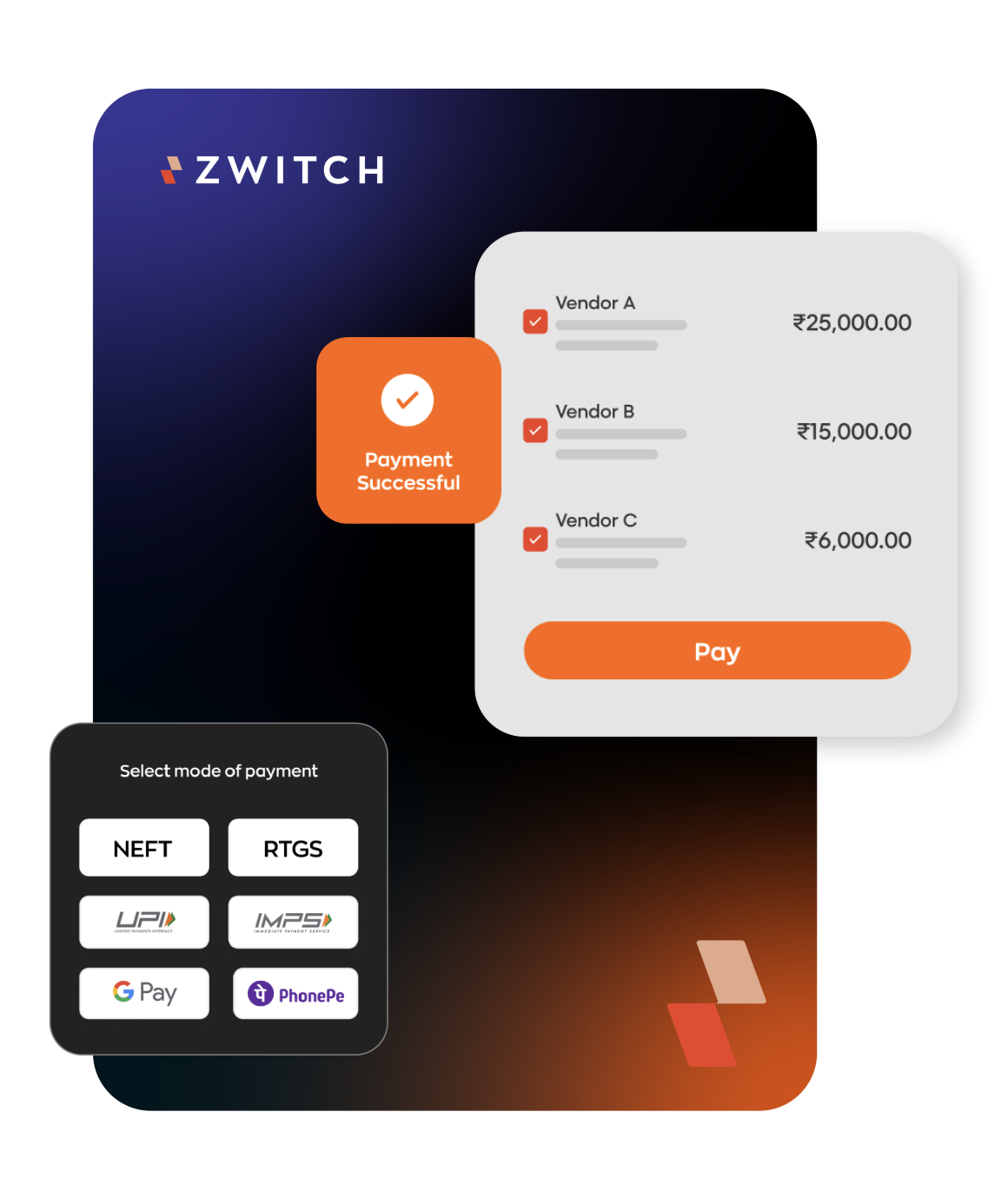
Zwitch helps businesses modernize their B2B payments with seamless APIs and real-time capabilities—bringing efficiency, speed, and compliance together.
Instant Settlement (15 mins) – Get funded instantly instead of waiting 3-5 business days, with manual withdrawal options for complete control
Payment Gateway & Links – Fast, secure payment collection with customizable payment links and pages—accept payments anywhere, from anyone
Dynamic QR Collections – Generate multiple QR codes for flexible collections, perfect for vendor networks and partner disbursals
Connected Banking & Payout APIs – Link your bank accounts directly, automate reconciliation, and initiate payouts in real-time to vendors and contractors
KYC & Verification Suite – Built-in PAN verification, bank account verification, and name matching to reduce fraud risk and compliance burden
B2B payments are no longer just about moving money they’re about moving smarter. Zwitch gives you instant settlements, flexible collections, automated payouts, and enterprise compliance all in one platform.
FAQs
What’s the Difference Between ACH and Wire Transfers?
ACH processes in batches (1-3 days) with low fees, ideal for recurring payments. Wire transfers settle same-day with higher fees, best for urgent, high-value transactions. Choose based on speed needs.
Why Are B2B Payments More Complex Than B2C?
B2B transactions involve larger amounts, longer payment cycles (Net 30-90), multi-layer approvals, and stricter compliance requirements like KYC and PCI-DSS. B2C is simple point-of-sale; B2B requires invoices, purchase orders, and detailed record-keeping.
What Compliance Requirements Apply to B2B Payments?
B2B processors must meet PCI-DSS (data security), KYC/AML (vendor verification), tax compliance, and cross-border regulations. These protect against fraud, money laundering, and regulatory penalties.
What’s the Best B2B Payment Method for International Transactions?
Wire transfers via SWIFT are traditional but slow and expensive. Modern digital platforms offer faster cross-border settlements with lower fees. Local payment methods vary by region (ACH in US, SEPA in EU), so choose based on speed needed, FX rates, and vendor preferences.