Digital payments are a part of everyday life now, from ordering groceries and paying bills to booking tickets and shopping online. With a few clicks, money moves across accounts in seconds. But sometimes, instead of a confirmation message, you see: “Transaction Failed”, “Payment Declined”, or “Payment Could Not Be Processed.”
This can be frustrating, especially when you’re not sure what went wrong. In this blog, we’ll explore the most common reasons why your online payment failed, what happens behind the scenes, and what you can do to avoid such issues in the future.
Why Did My Online Payment Fail?
An online payment can fail due to insufficient balance, incorrect details, exceeded transaction limits, authentication errors, bank server downtime, suspected fraud activity, or technical issues with the payment gateway or internet connection.
Understanding the reason helps you resolve the issue faster and avoid repeated failed transactions.
What Happens During an Online Payment?
To understand why payments fail, it helps to know what goes on during a typical online transaction. When you enter your card, UPI, or net banking details, the system routes this data through a payment gateway. This gateway connects with your bank or payment service provider to authorise the transaction.
The payment is verified using authentication methods such as OTP (for cards or net banking) or a UPI PIN. Once the bank approves, the payment gateway sends confirmation to the merchant, and your payment goes through.
This entire process takes a few seconds. But if anything goes wrong at any stage, like a server timeout or incorrect details, the payment fails.
Common Reasons for Online Payment Failure
1. Bank-Related Issues
Sometimes, the problem lies with your bank or account. These are some typical reasons:
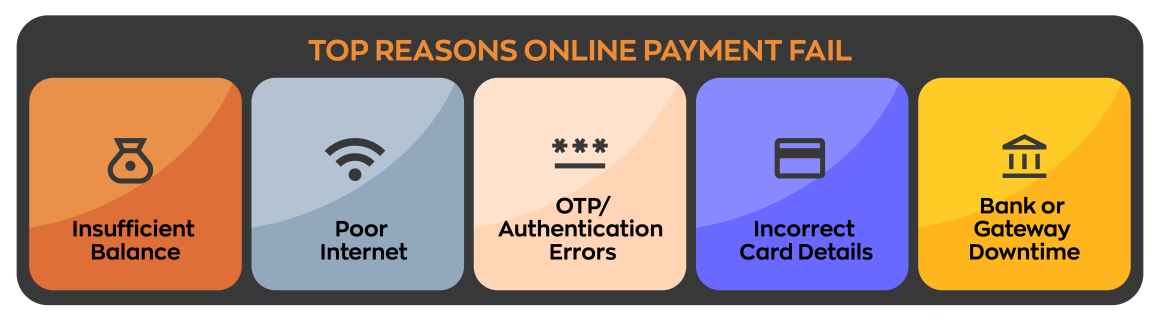
- Insufficient balance: If your account doesn’t have enough funds, the payment will be declined.
- Exceeded card or UPI limits: Banks place daily or per-transaction limits on cards and UPI handles. If you exceed them, your transaction won’t go through.
- Server downtime: Banks occasionally perform maintenance or face technical outages. During such times, authorisation might fail even if your account is in order.
2. Connectivity Problems
A slow or unstable internet connection can interrupt the transaction process. If the payment page doesn’t load fully or times out, the session may expire, resulting in failure.
3. Incorrect Payment Details
Entering wrong information is a common reason behind failed payments. This includes:
- Incorrect CVV or expiry date on a card.
- Mistyped card number or UPI ID.
- Errors in entering the OTP or UPI PIN.
Even a single digit can cause the system to block the transaction.
4. Authentication Failures
Banks and payment platforms require users to verify their identity during payments. If the authentication step fails, the payment will be cancelled. Common causes include:
- Delay in entering OTP.
- Not receiving the OTP due to network issues.
- Entering the wrong PIN or password.
- Expired session due to time-out.
5. Technical Glitches
Sometimes, the issue comes from the merchant’s website, the payment gateway, or your device. These include:
- Gateway timeout or internal server errors.
- Browser compatibility issues (especially with older versions).
- App crashes or bugs in merchant platforms.
- Cached data causing the page to reload incorrectly.
What to Do When a Payment Fails
If your online payment failed, here are some steps to follow:
- Check your bank account or UPI app to see if the amount was debited.
- If no money was deducted, wait a few minutes and try again.
- If money was debited but the transaction failed, note the transaction ID and contact the merchant or bank. In most cases, the amount will be refunded automatically within 5 to 7 working days.
- Clear your browser cache or use a different browser or app to try again.
- If using UPI, try switching to a different app or UPI ID.
- Avoid making repeated attempts without checking the status. It can lead to multiple deductions or failed entries.
How to Avoid Payment Failures in the Future
While some issues are beyond your control, many can be prevented with a few simple measures:
- Keep apps and browsers updated: Old versions may not support secure payment gateways.
- Ensure a stable internet connection before starting the transaction.
- Double-check your details before submitting—whether it’s a card number, UPI ID, or OTP.
- Use trusted apps and platforms that are RBI-compliant and regularly maintained.
- Don’t use public Wi-Fi for online payments to avoid security issues and connection drops.
- Be aware of transaction limits set by your bank for cards or UPI to avoid exceeding them.
- Avoid peak hours if possible, when traffic is high and systems are slower to respond.
For businesses, payment failures are not always user-related. The reliability of the payment infrastructure also plays an important role. Platforms like Zwitch are designed to support smoother transaction processing and help reduce avoidable technical disruptions across payment flows.
When Money Gets Debited but Payment Fails
This is one of the most worrying situations. But in most cases, it’s temporary. Here’s what typically happens:
- The payment gateway attempts to process your request but encounters an error midway.
- Your bank still receives the request and debits the amount.
- The merchant doesn’t get a confirmation, so the transaction is marked as failed.
- The unconfirmed amount is reversed within a few days, usually between 5 to 7 working days.
If the refund takes longer, you can raise a complaint with the merchant’s customer support. If that doesn’t resolve it, contact your bank and share the transaction ID. Most banks have dedicated support for failed payment issues.
Final Thoughts
A failed payment can be stressful, especially if it involves an urgent purchase or bill. But in most cases, the issue is temporary and easily resolved. Knowing what causes these failures and how to respond can save time and worry.
The next time your online payment fails, don’t panic. Check the reason, follow the steps, and if needed, reach out for support. Staying informed and being careful while making payments can help you avoid most of these problems altogether.
FAQ (Frequently Asked Questions)
1. Why does my UPI payment fail?
UPI payments can fail due to incorrect PIN entry, insufficient balance, exceeded transaction limits, bank server downtime, network interruptions, or technical issues between participating banks.
2. Why is my card declined even with sufficient balance?
A card may be declined despite sufficient balance due to exceeded daily transaction limits, international usage restrictions, suspected fraud detection triggers, expired card details, or failed OTP authentication.
3. How long does a failed transaction refund take?
Refunds for failed transactions are typically processed within 3 to 7 working days, depending on the bank and payment method.
4. Can I retry a failed online payment immediately?
If the amount was not deducted, you can retry after checking your payment details and internet connection. If the amount was debited, wait for confirmation or reversal before attempting again.
5. What happens if I retry a failed payment multiple times?
Repeated attempts may trigger bank security systems, temporarily block your card or UPI handle, or result in multiple pending deductions that require reversal.