Payments have always required a person to act. A customer clicks pay. A finance manager approves a transfer. A vendor submits an invoice, and someone processes it.
That is changing. AI agents are increasingly involved in workflows that involve money. They are booking travel, reordering inventory, paying contractors on milestone completion, and managing marketplace settlements. In each of these cases, the payment is not triggered by a human deciding in the moment. It is triggered by a system acting on logic.
This is what agentic payments mean. It is not a product category yet, but a real shift in what payment infrastructure needs to be capable of, and one that is arriving faster than most businesses are prepared for.
What Are Agentic Payments?
Agentic payments refer to transactions initiated and completed by AI agents operating within defined user or business boundaries, without requiring human input at each step. Instead of waiting for a person to trigger a payment, the system decides when and how money should move based on context, goals, and real-time inputs.
Unlike traditional automation, where every rule is predefined, agentic systems can interpret situations, take actions across multiple steps, and adapt to new conditions. The payment is not just executed—it is decided.
In practice, this means payments can be embedded into end-to-end workflows, where decision-making and execution happen within the same system, without manual intervention.
Agentic Payments vs. Payment Automation: What Is the Difference?
The distinction is important and easy to get wrong.
Traditional payment automation is rule-based and deterministic. If an invoice is due today, initiate a transfer. If a subscription renews, charge the card on file. The rules are written by humans. The system follows them.
Agentic payments are different in kind. An AI agent can receive a goal and decide what payment actions to take in pursuit of it, without a human defining every scenario in advance. The same agent might:
- Review completed work, verify a milestone, and release payment to a contractor automatically
- Monitor stock levels and trigger a purchase order with payment upon delivery confirmation
- Manage a marketplace settlement cycle: collecting funds, splitting to sellers, deducting fees, and releasing escrow without manual steps
- Handle subscription upgrades, downgrades, failed payment retries, and cancellations end-to-end
The payment is not the output of a rule. It is the output of a decision. That distinction is what makes agentic payments a meaningful infrastructure challenge, not just a workflow improvement.
Why This Is Happening Now
Two things have converged to make this real in 2025.
First, AI models can now use external tools. The current generation of large language models can call APIs, interpret responses, and take follow-up actions as part of a continuous reasoning loop. An agent can initiate a payment API call, read the response, and proceed based on the outcome—all within a single workflow. What was theoretical two years ago is practical today.
Second, India’s payment infrastructure is programmable in a way that supports agentic commerce. UPI Circle, UPI Reserve Pay, and UPI Autopay give AI agents legitimate, NPCI-sanctioned mechanisms to act on behalf of users within pre-authorized spending limits. The rails are there. In 2025, India processed over 20 billion UPI transactions in a single month. That infrastructure is ready for agentic use.
Globally, major payment networks have begun formalizing agentic frameworks: open protocols for agent-initiated transactions, virtual card generation for AI-controlled spending, and agent identity verification standards. The scale of the shift is significant: Morgan Stanley estimates that agentic commerce could account for $190 billion to $385 billion in e-commerce spending by 2030, capturing between 10% and 20% of online retail.
The question for most businesses is whether their own payment stack will be ready to participate in that shift.
What Agentic Payments Demands from Your Infrastructure
Payment stack modernization is often discussed as a technical initiative. In the context of agentic payments, it becomes a strategic one. The gap between agentic payment workflows and existing infrastructure is not about payment rails. UPI, IMPS, NEFT, and RTGS are capable rails. The gap lies in the control layer sitting on top of them.
A payment stack built for human-initiated transactions has several structural assumptions: a person initiates each payment, a person approves exceptions, and reconciliation happens periodically with human review. Agentic workflows break all three.
Here is what your infrastructure needs to support instead:
| Capability | Why It Matters for Agentic Workflows |
| API access across all payment modes | UPI, IMPS, NEFT, RTGS, and collections must be callable programmatically. Features locked behind a dashboard are inaccessible to AI agents. |
| Virtual accounts for auto-reconciliation | Every inbound payment must be self-attributing. At agentic volumes, manual matching is not possible. Virtual accounts per customer or order context solve this. |
| Inline identity verification | Bank account verification, PAN validation, and UPI VPA checks must be available as API calls at the moment a workflow needs them, not as separate offline processes. |
| Instant or on-demand settlement | Agentic workflows are often sequential. If step two depends on the confirmed settlement of step one, overnight batch cycles create blocking delays that require human intervention. |
| Recurring mandate management | Subscription and installment-based agentic commerce requires UPI Autopay and eMandate setup, modification, and cancellation via API—not through portals. |
| Webhook-native status delivery | Agents cannot poll for payment status efficiently at scale. Status updates, settlement confirmations, and failure events must be push-delivered. |
The test is simple: could an AI agent complete the entire workflow, including edge cases and exceptions, without a human logging into a dashboard? If the answer is no at any step, that is a gap.
The Trust Problem: When There Is No Human at the Checkout
Every existing payment security framework assumes a human is present, making a deliberate choice to transact. Fraud detection, authentication requirements, and chargeback rules are all built around this assumption.
Agentic payments break it. When an AI agent transacts, it is acting on authority previously granted by a user, not on a real-time human decision. This creates three specific risks:
- Scope drift: the agent interprets its mandate too broadly and executes transactions the user did not intend
- Liability ambiguity: if a transaction is disputed, it is unclear whether the user, the developer, or the AI platform is responsible
- Credential exposure: payment credentials passing between AI systems and payment processors create a new attack surface
The emerging architecture to address this involves three layers: pre-authorized spending mandates with defined limits, scoped tokens that encode exactly what an agent is permitted to do, and rich audit trails that trace every transaction back to the original user intent and the agent decision that triggered it.
For businesses building agentic payment flows, this means designing the authorization boundary before anything else. What is the agent permitted to pay, to whom, up to what amount, and under what conditions? These are not product decisions. They are infrastructure decisions that need to be enforced at the payment layer.
How to Prepare Your Payment Stack
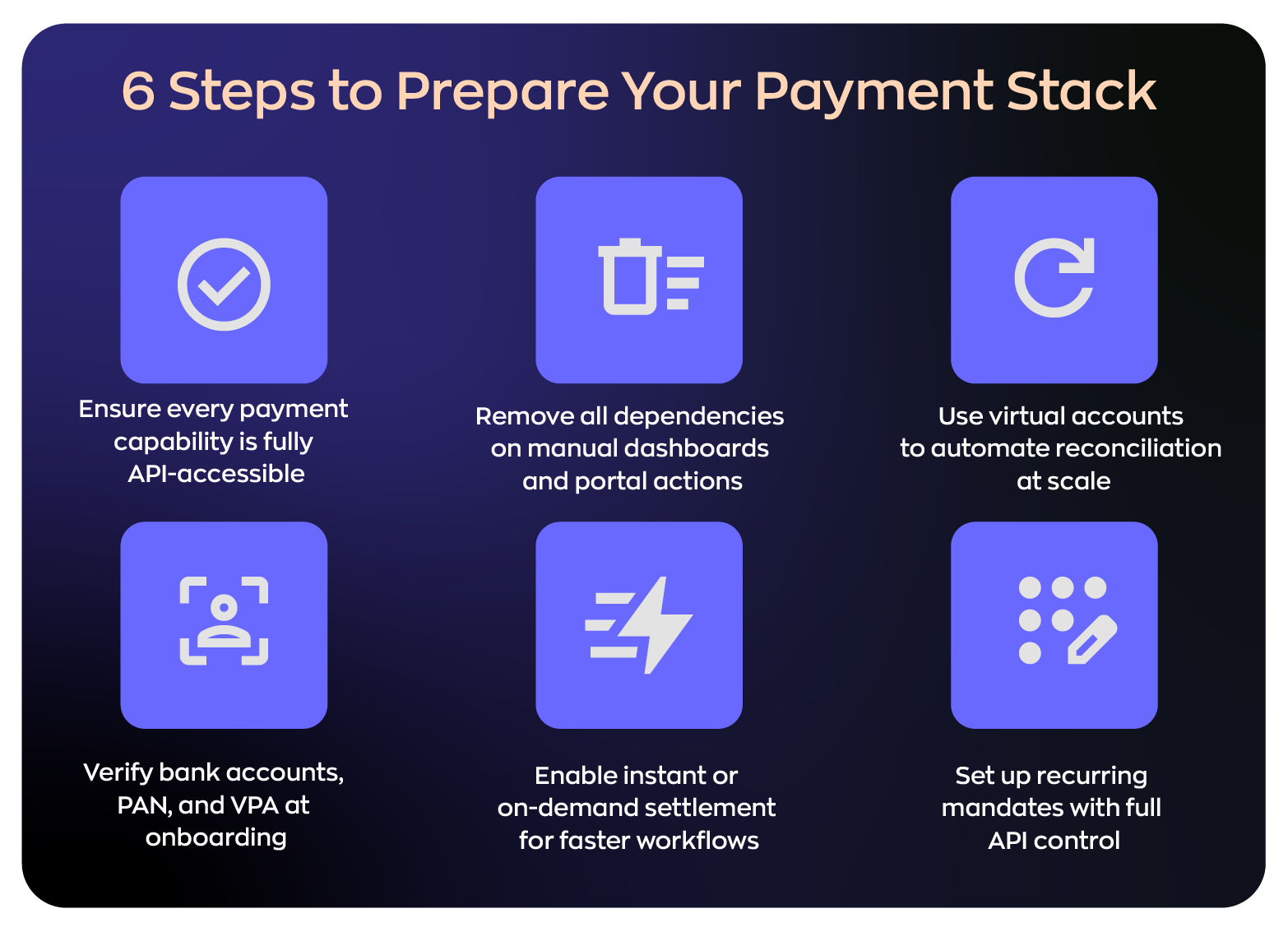
Preparing your AI payments infrastructure does not require rebuilding everything. It requires an honest audit of where your current stack will break under agentic load—and addressing those gaps in order of dependency.
Start with API coverage
Go through every payment capability you use. For each one, ask: Is this available via API without any dashboard interaction? Bulk payouts, refunds, mandate setup, and beneficiary management that require human-initiated portal steps are dead ends for agents. This mapping will show you your actual agentic surface area.
Implement virtual accounts before you scale
Virtual accounts are the foundation of automated reconciliation. Each customer, order, or workflow context gets a unique account number, and inbound payments are attributed automatically. Set this up before you need it at agentic volumes. Retrofitting it later is disruptive.
Embed verification at onboarding
Bank account verification, PAN checks, and UPI VPA validation are most efficient when run at onboarding, building a verified database that agentic workflows can query rather than running fresh checks per transaction. For new payees added dynamically, inline verification APIs need to be fast and reliable enough to avoid adding meaningful latency.
Audit your settlement window
Map the settlement lag in your current stack against the workflows you plan to automate. Any workflow where the next step depends on confirmed settlement—and where your current window is T+1 or longer—will require human intervention to proceed. Instant or on-demand settlement resolves this.
Get recurring mandates in order
If any planned workflow involves subscriptions or installment collections, UPI Autopay and eNACH infrastructure with full API control is non-negotiable. Mandate creation, modification, cancellation, and retry logic must all be programmable—not portal-configured.
How Zwitch Supports Agentic Payment Workflows
Zwitch is built API-first, which means agentic workflows can execute end-to-end without relying on dashboards or manual intervention. From collections and payouts to reconciliation and verification, every step can be triggered programmatically within a single flow.
This allows AI-driven systems to move money, validate counterparties, and track outcomes in real time—without breaking the workflow for human input.
If you are evaluating your payment stack for agentic readiness or planning to build automated payment workflows, our team can help you map what is possible today.
Final Thoughts
Agentic payments are not a distant scenario. The infrastructure is being built now at the protocol level by payment networks and at the product level by AI platforms. India, with UPI’s programmable architecture and the pilots already underway, is closer to this reality than most markets.
What matters for businesses is not whether agentic payments will arrive. It is whether your payment stack will be ready when your own workflows or your customers’ AI agents need to use it. The audit is the right starting point. The gaps will tell you exactly what to do next.
FAQs
What are agentic payments?
Agentic payments are transactions initiated and completed by AI agents operating within user-defined boundaries, without requiring human input at each step. Unlike rule-based automation, agentic systems apply contextual judgment to determine when and how to pay.
How are agentic payments different from automated payments?
Automated payments follow fixed rules set by humans in advance. Agentic payments involve AI systems that reason about context and goals, handling novel situations without a human defining every scenario. The shift is from rule-following to goal-directed action.
What payment infrastructure does an AI agent need to transact?
API access across all payment modes, virtual accounts for automated reconciliation, inline verification APIs, instant or on-demand settlement, webhook-based status delivery, and full API control over recurring mandates. Features that require portal interaction are inaccessible to agents.
What is UPI Reserve Pay, and why does it matter for agentic payments?
UPI Reserve Pay allows users to set a spending limit and delegate transaction authority to an AI agent within that limit, without requiring PIN entry for each transaction. It is the UPI mechanism that India’s agentic payment pilots are built on, enabling user-authorized autonomous transactions within a safe boundary.
What is the biggest risk in agentic payment workflows?
The core risk is that existing security frameworks assume a human is present at the moment of each transaction. When an agent acts autonomously, the trust model changes. Businesses need to define authorization boundaries clearly and enforce them at the payment infrastructure level—not just the application layer.
How should a CFO think about preparing for agentic payments?
Start with a payment stack audit: map which capabilities are truly API-accessible, identify settlement lag against planned workflow dependencies, confirm virtual account infrastructure is in place, and verify that verification processes are embeddable inline rather than requiring manual steps. These are infrastructure decisions, not technology experiments.